
Home › Blog › Implant vs Bridge: Which Is Better?
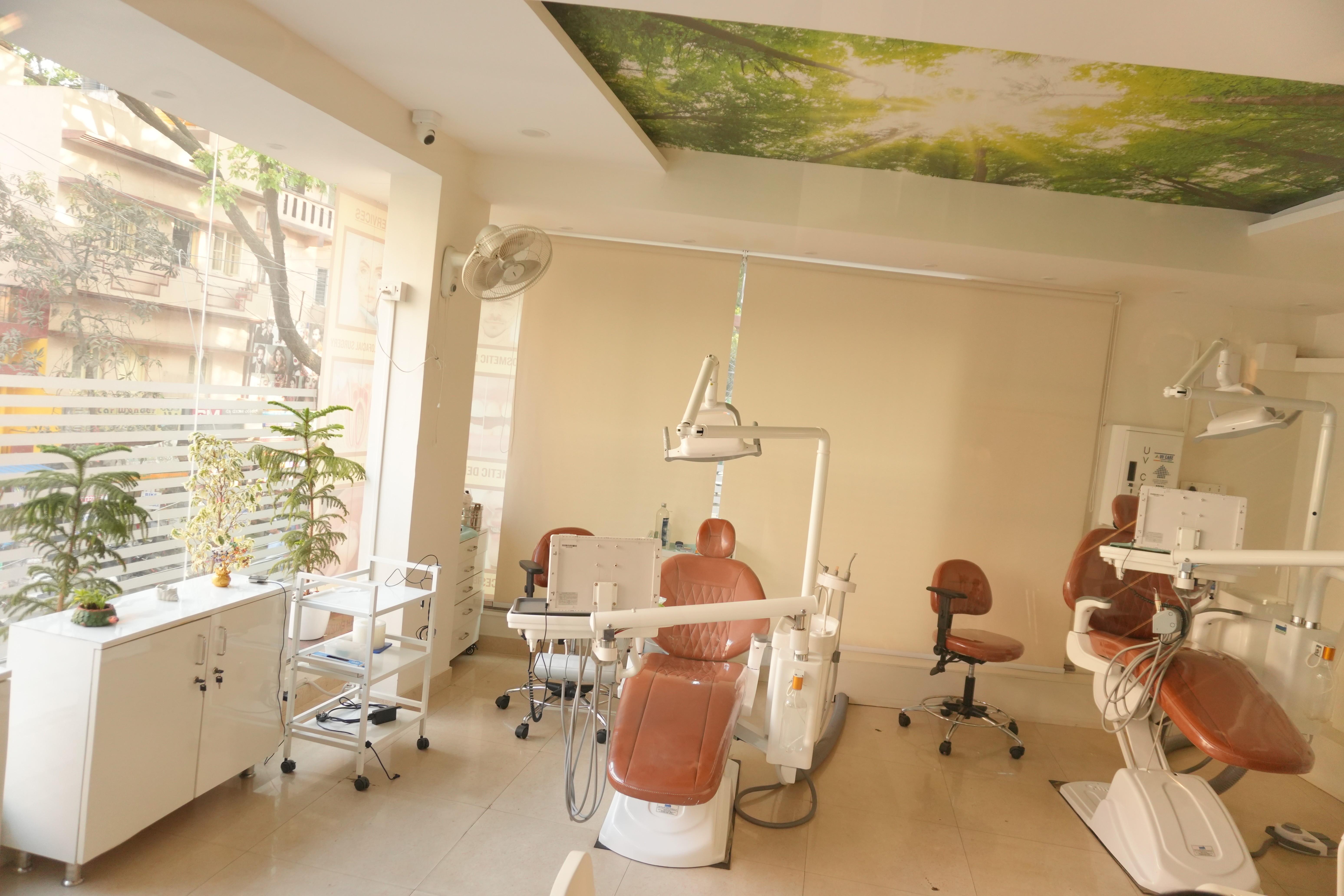
Single Tooth Implant vs Bridge: Which Is the Better Option for You?
For most healthy adults, a dental implant is the better long-term choice for replacing a single missing tooth. But a bridge has genuine advantages in certain situations. Here is how to decide which is right for your case.
For a single missing tooth, a dental implant is generally the better long-term option. It does not damage adjacent teeth, prevents bone loss in the jaw, and can last a lifetime with proper care. A dental bridge is faster, less expensive upfront, and a reasonable choice in specific situations. The right answer depends on your bone health, the condition of your neighbouring teeth, your budget, and how long you want the result to last.
At Dr. Arati's Dental & Surgical Practice in Koramangala, patients often ask this exact question. This guide gives you a clear, honest comparison -- not a sales pitch for either option -- so you can make the best decision for your situation.
- Dental implant: best long-term option for most adults -- no damage to adjacent teeth, prevents bone loss, lasts 20+ years.
- Dental bridge: lower upfront cost, faster treatment, no surgery -- but requires filing down two healthy teeth and does not prevent bone resorption.
- Cost: implant Rs 25,000-60,000 complete; bridge Rs 15,000-35,000. Over 15-20 years, total costs are often comparable.
- Lifespan: implant 20+ years; bridge typically 10-15 years before replacement.
- A bridge may be better if adjacent teeth already need crowns, if bone loss is significant, or if surgery is medically unsuitable.
- Only a clinical assessment with X-rays can determine the best option for your specific case.
Not sure which option is right for you?
Book a consultation with Dr. Arati. She will assess your bone health, review your X-rays, and give you a clear recommendation -- no pressure, no upselling.
Book on WhatsApp Call +91 99000 94029What Is a Dental Implant and What Is a Dental Bridge?
What is a dental implant?
A dental implant is a titanium post placed directly into the jawbone. It acts as an artificial tooth root. Once the bone grows around it -- a process called osseointegration that takes 3 to 6 months -- a custom crown is attached on top. The result is a freestanding tooth replacement that looks and functions like a natural tooth, involves no other teeth, and stimulates the jawbone the way a natural root would.
What is a dental bridge?
A dental bridge is a fixed prosthesis that spans a gap left by a missing tooth. It consists of a false tooth (the pontic) held in place by two crowns cemented onto the teeth on either side of the gap (the abutment teeth). To fit those crowns, the abutment teeth must be permanently filed down -- removing healthy enamel and dentine that cannot be restored. The bridge is then cemented in place and is not removable.
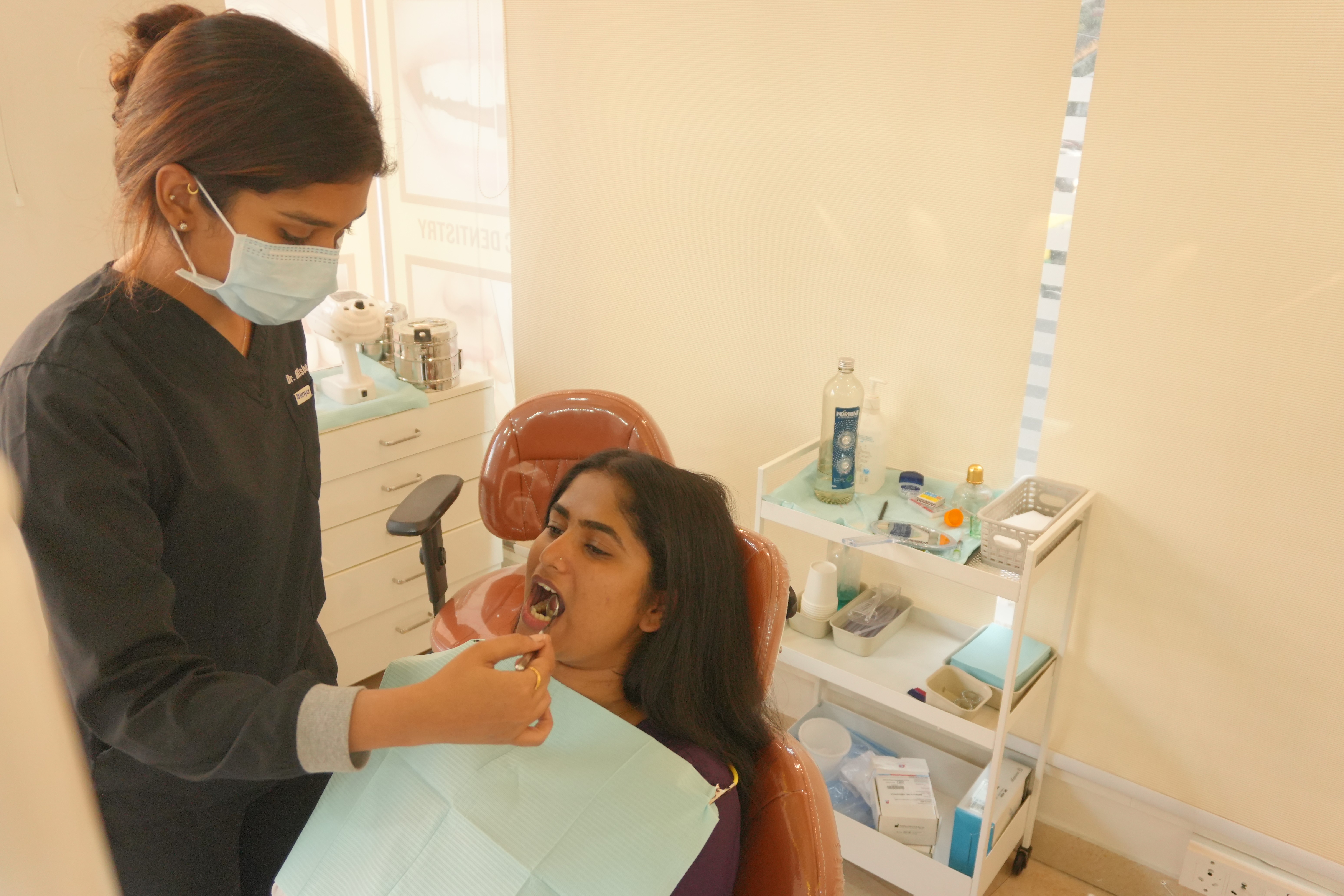
Every implant and bridge treatment at Dr. Arati's practice begins with a thorough clinical assessment and X-ray review
Dental Implant vs Bridge: The Full Comparison
Here is a direct feature-by-feature comparison to show exactly how these two options differ:
| Feature | Dental Implant | Dental Bridge |
|---|---|---|
| Effect on adjacent teeth | None -- fully independent | Two teeth permanently filed down |
| Prevents jawbone loss | Yes -- stimulates bone like a natural root | No -- bone resorption continues under the gap |
| Lifespan | 20+ years, often lifetime | 10-15 years typically |
| Upfront cost (Bengaluru) | Rs 25,000 - Rs 60,000 | Rs 15,000 - Rs 35,000 |
| Treatment time | 3-6 months total | 2-4 weeks |
| Surgical procedure required | Yes -- minor oral surgery | No surgery needed |
| Feels like a natural tooth | Very natural -- independent root | Good, but relies on anchor teeth |
| Cleaning and maintenance | Brush and floss normally | Special flossing under pontic needed |
| Risk to adjacent teeth | None | Increased decay risk under crowns over time |
| Bone grafting sometimes needed | Yes, if bone is insufficient | No |
| 20-year total cost estimate | Rs 30,000 - Rs 65,000 (may not need replacement) | Rs 30,000 - Rs 70,000+ (likely 1-2 replacements) |
Rows highlighted in gold show where a dental implant has a clear clinical advantage. The bridge wins on upfront cost and treatment speed -- both of which are legitimate factors depending on your situation.
Why Is a Dental Implant Better for Most Patients?
It does not harm your other teeth
This is the most important clinical difference. A bridge requires permanently grinding down two adjacent teeth to anchor the false tooth in the middle. Even if those teeth are completely healthy, they must be reduced to stumps. This removes irreplaceable tooth structure and increases the risk of decay, nerve damage, and the eventual need for root canal treatment on those teeth.
An implant stands alone. It does not touch adjacent teeth at all.
It prevents bone loss in the jaw
When a tooth is removed, the jawbone at that site begins to shrink -- a process called bone resorption. A natural tooth root stimulates the bone around it with every bite. Without a root, that stimulation stops and the bone gradually reduces in volume and density.
A dental bridge replaces the visible tooth but not the root. Bone resorption continues under the bridge. Over years, this can cause the gum line to recede under the pontic, creating a visible gap and compromising the bridge's appearance and fit.
A dental implant replicates the root. It integrates with the bone and transmits bite forces into the jaw -- preserving bone volume for the long term.
It lasts significantly longer
A well-maintained dental bridge typically needs replacement after 10 to 15 years. Each replacement involves re-preparing the abutment teeth, which further weakens them. Over two or three replacements, the supporting teeth may eventually fail entirely, requiring their own extraction and replacement.
A dental implant, with proper care, can last a lifetime. The crown on top may need renewal after 15 or more years, but the titanium fixture in the bone rarely needs to be replaced.
It is easier to clean
You brush and floss a dental implant exactly like a natural tooth. A bridge requires threading floss under the pontic using a floss threader or interdental brush to clean the area beneath the false tooth -- where plaque builds up and decay can develop on the abutment teeth if cleaning is neglected.

Dr. Arati uses X-rays and clinical examination to determine the best tooth replacement option for each patient
When Is a Dental Bridge the Better Choice?
A bridge is not always the inferior option. There are genuine clinical situations where it is the more appropriate choice:
When adjacent teeth already need crowns
If the teeth on either side of the gap already have large fillings, significant decay, or are going to need crowns for other reasons, using them as bridge abutments makes sense. You are not sacrificing healthy tooth structure -- those teeth need to be capped anyway.
When there is significant bone loss
If the jawbone at the gap site has reduced significantly over years, placing an implant may require a substantial bone graft first. In some cases the bone loss is too extensive for grafting to be predictable, and a bridge becomes the safer, more reliable option.
When surgery is medically unsuitable
Certain medical conditions -- uncontrolled diabetes, active cancer treatment, severe bleeding disorders, or medications that affect bone healing -- can make implant surgery unsuitable or high-risk. A bridge achieves tooth replacement without surgery.
When treatment speed matters
A bridge can be completed in two to four weeks. An implant takes three to six months for full integration. For patients who need a tooth replaced quickly for an important event or professional reason, a bridge delivers a faster result. In some cases, a temporary bridge can be placed while an implant heals.
When upfront cost is the primary constraint
A bridge costs less upfront. For patients where budget is the deciding factor and longer-term replacement is acceptable, a bridge is a legitimate choice. EMI options at Dr. Arati's practice can help make implants more accessible, but a bridge remains a clinically sound alternative when an implant is not possible.
Important: A bridge should not be the automatic default simply because it is cheaper. Grinding down two healthy teeth is a significant, permanent intervention. If those teeth are healthy, an implant is worth serious consideration even at a higher cost.
Who Should Choose an Implant and Who Should Choose a Bridge?
Dental Implant Is Better For You
- Adjacent teeth are healthy and untouched
- You want the longest-lasting solution
- You have adequate jawbone (or can have a graft)
- You are a healthy adult with no contraindications
- You want the most natural look and feel
- You want the easiest long-term maintenance
- You want to preserve the adjacent teeth
A Bridge May Be Better For You
- Adjacent teeth already need crowns or have large restorations
- There is significant bone loss at the site
- Surgery is medically unsuitable for you
- Treatment speed is a priority
- Upfront cost is a significant barrier
- You prefer to avoid surgery entirely
The honest answer: only a clinical examination with X-rays can determine the right choice for your specific case. Dr. Arati will assess your bone health, adjacent teeth, and overall dental health before making any recommendation.
How Do the Costs Compare Over Time?
The upfront cost comparison clearly favours a bridge. But the longer the time frame, the closer the two options get -- because bridges require replacement in a way implants typically do not.
| Time Point | Dental Implant (single) | Dental Bridge (3 units) |
|---|---|---|
| Year 0 -- Initial cost | Rs 25,000 - Rs 60,000 | Rs 15,000 - Rs 35,000 |
| Year 10-15 -- Replacement? | Unlikely (crown may eventually need renewal) | Likely full bridge replacement: Rs 15,000-35,000 |
| Year 20-25 -- Replacement? | Crown may need renewal: Rs 8,000-15,000 | Second bridge replacement possible: Rs 15,000-35,000 |
| Hidden costs | Bone graft if needed (Rs 10,000-20,000) | Increased decay risk on abutment teeth; possible root canals |
| Estimated 20-year total | Rs 30,000 - Rs 75,000 | Rs 30,000 - Rs 70,000+ (often higher with complications) |
Over a 20-year period, the total cost of a dental implant and a bridge become comparable -- and the implant carries significantly fewer risks to your other teeth and your jawbone. EMI options at Dr. Arati's practice can make the higher upfront cost of an implant more manageable. Learn more on our dental implants page.
What Does Each Procedure Involve?
Dental implant procedure -- step by step
- Consultation and X-ray/CBCT assessment -- bone volume and density evaluated
- Bone graft (if needed) -- healing takes 3-4 months
- Implant placement surgery -- under local anaesthetic, 60-90 minutes per implant
- Osseointegration (healing) -- 3-6 months for bone to integrate around the implant
- Crown fabrication and fitting -- impressions taken, custom crown placed
- Total time: 3-6 months (or up to 9-12 months if bone grafting needed)
Dental bridge procedure -- step by step
- Consultation and assessment -- adjacent teeth evaluated
- Tooth preparation -- abutment teeth filed down permanently under local anaesthetic
- Impressions taken -- sent to a dental laboratory for bridge fabrication
- Temporary bridge fitted -- worn for 1-2 weeks while permanent bridge is made
- Permanent bridge cemented -- adjusted and fixed in place
- Total time: 2-4 weeks
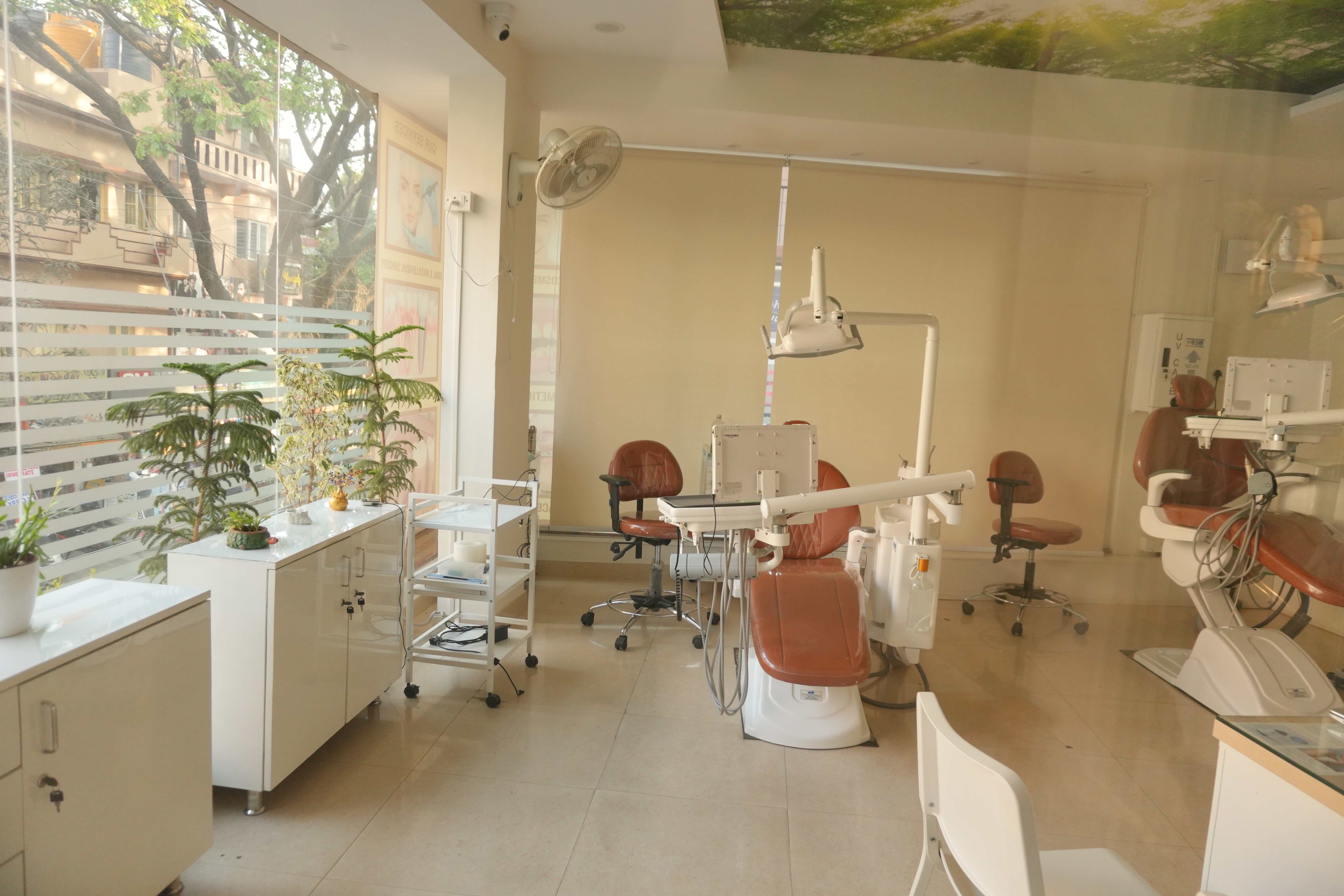
Dr. Arati's practice is equipped for both implant surgery and bridge preparation, with full in-house diagnostic facilities
Speak Directly With Dr. Arati
Have questions about which option suits your case? Dr. Arati will review your X-rays and give you a clear, unbiased recommendation. No obligation to proceed.
Message on WhatsApp Call the ClinicWhat Questions Should You Ask Before Choosing?
Before agreeing to either an implant or a bridge, these are the questions worth asking your dental surgeon:
- "Are my adjacent teeth healthy?" -- If yes, a bridge involves sacrificing that health unnecessarily.
- "Do I have enough bone for an implant?" -- Only an X-ray can answer this. Ask for the result in plain terms.
- "What is the long-term outcome for each option in my specific case?" -- A good surgeon will give you both sides honestly.
- "What happens if the bridge fails in 10 years?" -- You need to understand the replacement path, especially if abutment teeth weaken.
- "What is included in the full cost?" -- For both options, ask for a complete written quote covering all components and potential additional procedures.
Why Patients in Koramangala Trust Dr. Arati for Both Implants and Bridges
Patients from Koramangala, 4th Block, S.T. Bed, HSR Layout, BTM Layout, Jayanagar, and Indiranagar visit Dr. Arati's practice for a single reason: she gives honest advice. She does not default to implants because they cost more, and she does not default to bridges because they are faster. She assesses each case on its merits and recommends what is genuinely right for that patient.
As a Senior Maxillofacial and Dental Surgeon with 25+ years of experience, Dr. Arati has placed dental implants, placed bridges, and handled the complex surgical cases -- bone grafting, wisdom tooth removal, root canal treatment -- that sometimes need to be done before a replacement tooth can be placed. All of this is handled in one practice, by the same surgeon.
Additional services at the practice include dental crowns, cosmetic dentistry, and Dermapen 4 microneedling for facial aesthetics.

Dr. K Arati Rao
Senior Maxillofacial & Dental Surgeon · 25+ Years Experience · Koramangala, BengaluruDr. Arati specialises in dental implants, oral and maxillofacial surgery, and full-mouth rehabilitation. Her practice is built on root-cause diagnosis and honest clinical recommendations. She treats every patient as an individual -- presenting options clearly, explaining trade-offs, and recommending what is genuinely right for that person's teeth, bone, and long-term health.
Frequently Asked Questions: Implant vs Bridge
The Bottom Line: Implant or Bridge?
For most healthy adults with adequate bone, a dental implant is the better long-term investment. It preserves adjacent teeth, prevents bone loss, lasts longer, and is easier to maintain. The higher upfront cost and longer treatment time are the main trade-offs -- both of which can be managed with EMI options and realistic treatment planning.
A bridge is not a bad option. It is the right choice for specific situations: when adjacent teeth already need crowns, when surgery is not suitable, when bone loss is too significant for grafting, or when treatment speed is a priority.
The only way to know which is right for you is a clinical assessment. Dr. Arati will review your X-rays, assess your bone and adjacent teeth, and give you a frank recommendation -- not whichever option costs more or is quicker to place.
Explore more: Dental Implants · Dental Crowns · Root Canal Treatment · Wisdom Tooth Removal · All Blog Articles
Start Your Implant or Bridge Consultation Today
Get a clear, honest recommendation from Dr. Arati -- Koramangala's trusted oral and maxillofacial surgeon. Written cost estimate provided before any procedure. EMI options available.
Book on WhatsApp Call +91 99000 94029 Get Directions